Martin Luther: Finding God behind the Cross
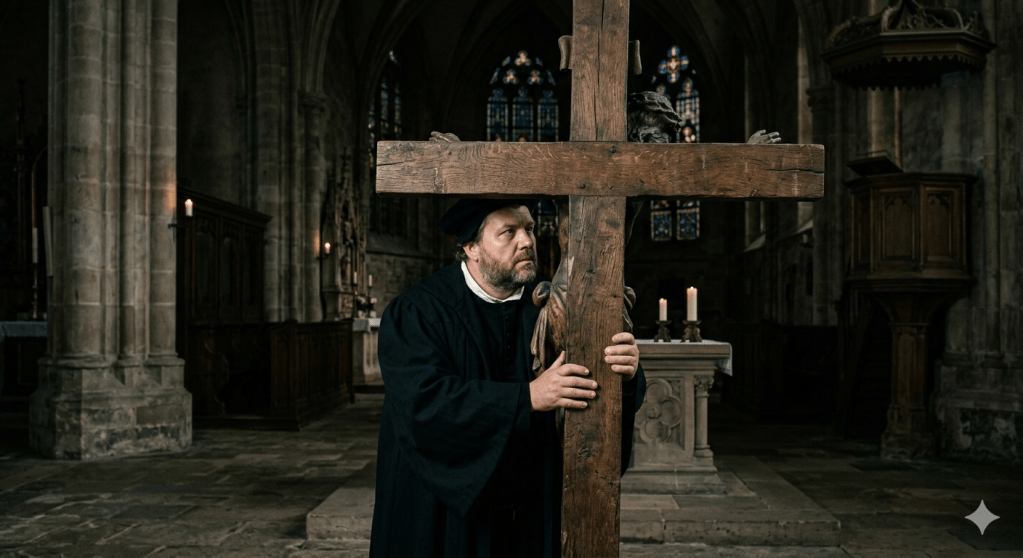
If you are trying to find God, looking for His glory, His power and His majesty on earth, you will never find Him. If you are looking for Him in the success and strength of men, He will remain hidden from you. God is not found where you would think to look for him, but is more often found where He seems most absent.
Rejecting humanity’s impulse to look for God in worldly power or rational majesty, Martin Luther’s “theology of the cross” asserts that the true God is paradoxically revealed only where He appears most hidden: in the humility, in the suffering, and in the perceived weakness of the crucified Christ.
The Author of Reformation: Beyond the 95 Theses
While popular history often tethers Martin Luther solely to the doors of the Castle Church in Wittenberg, his theological revolution was not merely a protest against institutional corruption. It was a fundamental reorientation of how humanity relates to the Divine. In his early years as an Augustinian monk, Luther was haunted by anfechtungen, deep spiritual trials and anxieties, regarding his standing before a holy God. He found that the medieval “theology of glory,” which emphasized man’s ability to move toward God through reason and works, only served to increase his despair.
The Heidelberg Disputation: The Birth of a New Perspective
In April 1518, just months after the 95 Theses sparked the firestorm that became the Protestant Reformation, Luther was called to defend his views before the leaders of his Augustinian order in Heidelberg. The Heidelberg Disputation presented his most profound early theological framework. While the 95 Theses focused primarily on the sale of indulgences, at Heidelberg he expanded his argument to address the very core of theological epistemology: How do we know God?
In Thesis #19 of the Heidelberg Disputation, Luther struck at the heart of theologia gloriae, theology of glory. He stated that a person is not truly a theologian if he is looking for God’s invisible attributes in the created world. In this, he expressed the teaching of the Apostle Paul who wrote of those who became fools exchanging the glory of God for an image in the likeness of man (Rom 1:22-23). In Thesis #20, Luther pivoted, defining the true theologian. He posited that a true theologian practices theologia crusis, theology of the cross, seeing and comprehending the manifest things of God in the suffering and crucifixion of Christ. God does not display His glory to the world, but instead is a God who hides Himself (Isa. 45:15). Finally, in Thesis #21, Luther distinguished between the two types of theologians, noting that a theologian of the cross will call a thing what it actually is, rather than masking suffering with talk of “glory.” The Apostle Paul wrote to the church in Philippi that there are many who walk as enemies of the cross of Christ, focusing on themselves and on earthly things rather than on God manifest on the cross (Phil. 3:18-19).
Theology of Glory vs. Theology of the Cross
To Luther, theologia gloriae was the natural default of the fallen world. It is man’s attempt to find God in success, health, political power, and moral perfection. The ‘theologian of glory’ looks at the world and expects God to look like a bigger, better version of human strengths. Luther argued that this visible God is an idol of our own making. He believed that God cannot be found in or measured by human findings, standards, or thoughts.
Conversely, the ‘theology of the cross’ presents the ‘hidden God’ (Deus absconditus). Luther posited that because of human sin and the limits of our reason, God chooses to reveal Himself “under the opposite.” God is hidden behind the cross because the cross is the ultimate symbol of failure, shame, and death. Yet, it is precisely in this ‘hiddenness’ that God’s love is most fully manifest. God hides in order to not be found where humans want to find Him. By dying as a criminal, God destroyed our attempts to earn His favor and instead, through the cross offers a grace that meets us in our brokenness. God also hides in order to be found where He wants to be found. In this case, God wants us to look for and to find Him in Christ crucified (1 Cor. 2:2).
Conclusion: Calling a Thing What It Is
Martin Luther recognized that the “theologian of glory,” the theologian who uses human reason to search for visible glory in man or in the beauty of the natural world, will never succeed in finding God. Even were we to find God, He is so much greater than us that to see Him in all His glory, we would be blinded. He suggested instead that the “theologian of the cross,” he who comprehends God as manifest in the suffering of Christ, will succeed in finding God. He will not find an obviously visible God, but instead Glory hidden behind the cross. This theology demands that we stop looking for God in the heavens and start looking for Him in the wounds of Christ and the suffering of our neighbors. In the end, the cross is not a barrier to knowing God, but the only door through which He allows Himself to be truly found.
Bibliography
Luther, Martin. “The Heidelberg Disputation.” In The Book of Concord.
Dillenberger, John. God Hidden and Revealed: The Interpretation of Luther’s Deus Absconditus and Its Significance for Religious Thought. Philadelphia: Muhlenberg Press, 2016.
Paulson, Steven D. “Luther on the Hidden God.” Word & World 19, no. 4 (Sept., 1999): 363–71.
Scaer, David P. “The Concept of Anfechtung in Luther’s Thought.” Concordia Theological Quarterly 47, no. 1 (1983): 15-30.

